


Opinions, analysis and commentary
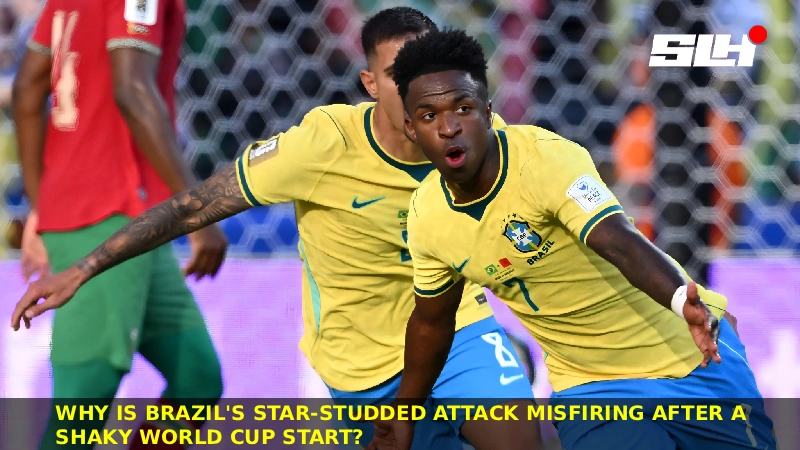


Brazil’s attack is misfiring because the structure built to control games instead created the exact gap Morocco needed to score first. Ninety nervy minutes at MetLife Stadium produced a 1-1 draw, an underlying expected goals total that favored the supposed underdog, and an admission from Carlo Ancelotti that his side never found balance. Vinícius Júnior’s solo equalizer papered over those cracks rather than fixing them. Whether Brazil’s front four settles into a repeatable pattern or keeps relying on individual brilliance becomes the story heading into the Haiti match.
Brazil’s tournament opener didn’t go to script. A 1-1 draw with Morocco at MetLife Stadium saw them concede inside 21 minutes and never fully wrestle back control, with Vinícius Júnior’s 32nd-minute equalizer, a driving run finished with a curling right-footed strike, the only thing standing between Brazil and a losing start.
The underlying numbers back up what the eye saw. Brazil generated 1.23 expected goals to Morocco’s 1.53, meaning the supposed underdog created the better quality chances across 90 minutes, while Morocco also outshot Brazil 12 to 6 in the first half alone. Ancelotti was blunt afterward, admitting “we did not play well, a very imbalanced team.”
Ancelotti’s setup paired Alisson behind a back four of Danilo, Marquinhos, Gabriel Magalhães and Alex Sandro, with Casemiro and Bruno Guimarães screening in midfield. Ahead of them, Raphinha and Lucas Paquetá supported Vinícius and Matheus Cunha in a front four that shifted between a 4-2-3-1 and a 4-4-2 depending on possession.
That fluidity was supposed to create control. Instead, it opened exactly the gap between Brazil’s midfield pivot and back line that Morocco needed, with Ismael Saibari’s opener arriving off a swift counter set up by Brahim Diaz that moved straight through that same space, exposing how easily the ball travelled through Brazil’s midfield once possession turned over.
Neymar’s absence has nothing to do with selection and everything to do with recovery. The all-time leading scorer is working back from a torn right calf and wasn’t even part of the matchday squad against Morocco.
Ancelotti has already named Vinícius as his attack’s frontline leader regardless of when Neymar returns, praising the dangerous edge he showed against Morocco and backing him to have a strong, even great, tournament. Whether adding Neymar back in eventually solves Brazil’s rhythm problem or complicates an already unbalanced shape remains one of the bigger open questions of the group stage.
Brazil’s group stage attacking output has been sliding for over a decade. As hosts in 2014, they scored eight goals across three group games, a number that dropped to five in 2018 and just three in 2022, a campaign they still topped despite a shock loss to Cameroon in the final round.
| World Cup | Goals (Group Stage) | Group Record | Notable Trend |
| 2014 (Host) | 8 goals in 3 games | 2W 1D 0L | Free-flowing, helped by home advantage |
| 2018 | 5 goals in 3 games | 2W 1D 0L | Slow starts, late breakthroughs |
| 2022 | 3 goals in 3 games | 2W 0D 1L | Lowest output, still topped the group |
| 2026 (Opener) | 1 goal, xG 1.23 | 0W 1D 0L | Trailed 0-1, rescued in the second half |
One goal from an underwhelming 1.23 expected goals return continues that decline, salvaged only by a moment of individual brilliance rather than a repeatable pattern in build-up. The trend suggests Brazil’s attack has leaned more on isolated quality than collective rhythm, even as the talent in the squad has stayed elite.
Brazil’s second group game against Haiti in Philadelphia on June 19 is the real test of whether Morocco’s problems were a one-off or something more permanent. Ancelotti has signaled that changes to the lineup are possible, and a lower-ranked opponent should let Brazil rebuild rhythm without the physical pressure Morocco applied throughout the first match.
“We started on a really bad note,” Vinícius admitted after the Morocco draw, and Haiti gives Brazil a clean chance to prove that start wasn’t who they actually are. If the same imbalance shows up again against a team they’re heavily favored to beat, the FIFA World Cup 2026 Brazil attack-struggles narrative stops looking like a one-match story and starts looking structural.
Stay updated on every twist and turn of the summer transfer window and catch all the live football action with Sports Live Hub (SLH).
Accessing a high-quality hub sports live stream is essential for fans following the matches of the World Cup season. SLH provides a verified directory of official broadcasting partners, ensuring you never miss a moment of the action from the Premier League or Liga Portugal or World Cup.
Our sport hub live streaming dashboard offers real-time tactical overlays, player fitness stats, and live transfer probability tickers. As the WC 2026 saga develops, SLH is the destination for integrated sports data and high-definition viewing.
If you are wondering how to watch Sports live for free, SLH maintains a curated list of official free-to-air (FTA) broadcasters and legitimate digital promotional windows. We help fans find legal, cost-free ways to enjoy global sports while ensuring safety from unauthorized streaming sites.
Why was Neymar benched against Morocco?
Neymar wasn’t dropped; he was unavailable through injury. He’s recovering from a torn right calf and wasn’t even named in the matchday squad for the Morocco game.
What formation is Brazil using at the 2026 World Cup?
Brazil used a fluid 4-2-3-1 that shifted into a 4-4-2 against Morocco. Casemiro and Bruno Guimarães anchored midfield behind Raphinha, Paquetá, Vinícius, and Cunha.
How many goals has Brazil scored at the 2026 World Cup so far?
Brazil has scored one goal in one match so far. That came from Vinícius Júnior’s equalizer in the 1-1 draw against Morocco.
Is Brazil still the favorite to win the 2026 World Cup?
No, pre-tournament models already had Brazil as only the sixth most likely to win. The underwhelming Morocco draw hasn’t strengthened that case, though Ancelotti insists one match doesn’t define a campaign.
Who are Brazil’s key attacking players at the 2026 World Cup?
Vinícius Júnior leads Brazil’s attack, with Raphinha, Paquetá and Cunha in support. Neymar remains a potential addition once he recovers from his calf injury.
 football
 football
 cricket