



Opinions, analysis and commentary



The 2026 ICC Men’s T20 World Cup did more than just crown a champion; it effectively shattered our collective understanding of what a “competitive” total looks like. Hosted across the subcontinent, the tournament saw the 250-run mark breached with such frequency that it suggests a permanent, perhaps irreversible, shift in batting aggression. India’s eventual triumph on home soil was built on individual performances that felt less like traditional cricket and more like a high-octane highlights reel.
Here is a breakdown of the ten most influential displays from a tournament that redefined the shortest format.
Centuries were common this year, but Samson’s 89 in the Ahmedabad final carried the most situational weight. Entering the crease after the openers had already set a frantic pace, he dismantled the New Zealand spin attack with a clinical, horizontal-bat approach. That innings also saw him clear the ropes for his 24th six of the tournament—a record that suggests Samson has finally found the consistency to match his undeniable talent.
In a final where nearly 400 runs were scored, Bumrah’s 4/15 feels like a statistical error. He didn’t just provide containment; he surgically removed New Zealand’s primary threats, Finn Allen and Tim Seifert, during the power play. Maintaining an economy rate under 4.0 in such a high-scoring environment is arguably the most impressive feat of the entire tournament.
During the first semi-final, Finn Allen produced what many are calling the most violent hundred in the history of the World Cup. Reaching triple figures in just 33 deliveries, he systematically targeted the Proteas’ pace battery. This performance appears to indicate that the traditional “rebuilding phase” in T20S is effectively dead; Allen simply refused to let the run rate dip, regardless of the wickets falling at the other end.
Pakistan’s campaign may have been inconsistent, but Sahibzada Farhan was a constant. By amassing 383 runs, he moved past Virat Kohli’s 2014 record for the most runs in a single edition. His back-to-back centuries against Namibia and Sri Lanka showed a level of technical adjustment that few of his contemporaries could replicate.
At just 19 years old, Canada’s Yuvraj Samra became the youngest centurion in T20 World Cup history. His 110 against a full-strength Kiwi side was no fluke of small boundaries. Instead, it was a disciplined display of “v-zone” hitting. This innings suggests the gap between Associate nations and the established elite is closing faster than we previously assumed.
While batters dominated the headlines, Shepherd’s 5/20 was a rare win for the bowlers. Using a nuanced mix of cross-seam deliveries and cutters, he decimated the South African middle order. In terms of pure efficiency, it remains the standout bowling performance of the 2026 edition.
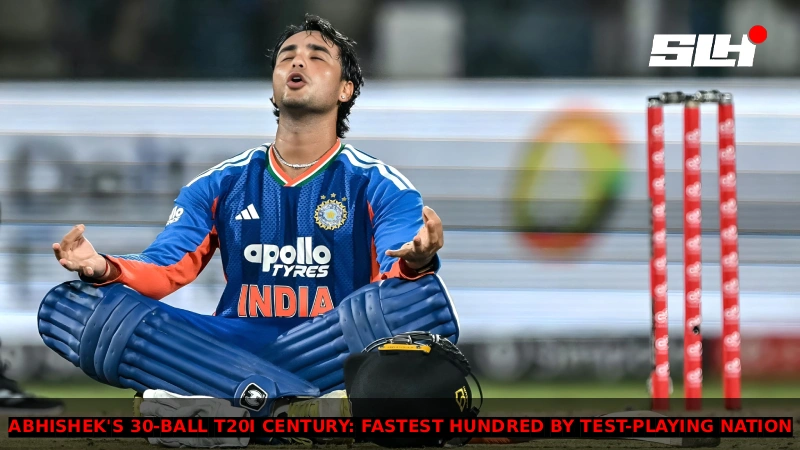
India’s victory in the final was largely a product of the pressure applied early on. Abhishek Sharma’s 18-ball fifty set a new record for the fastest half-century in a World Cup knockout match. His intent was almost reckless, yet it forced New Zealand into defensive fields before the fourth over was even bowled.
Nissanka recorded the first century of the tournament, an unbeaten 100 on a tricky, two-paced Colombo surface. Unlike the power-hitters, his innings was an academic display of placement and strike rotation. It proved that even in an era of 250-run scores, there is still room for a refined, anchoring presence.
Leading England in a high-pressure chase at Kandy, Harry Brook’s unbeaten century was a clinic in middle-over management. His ability to manipulate the field against high-quality swing kept England’s semi-final hopes alive when the odds were heavily against them.
Zimbabwe’s Brian Bennett finished the tourney with an astronomical average of 146.00. His 97* against New Zealand was perhaps the most resilient “lone wolf” performance we saw. He nearly pulled off an improbable upset, solidifying his reputation as one of the most reliable middle-order finishers in the current game.
| Category | Performer | Metric |
| Most Runs | Sahibzada Farhan | 383 Runs |
| Most Wickets | J. Bumrah / V. Chakaravarthy | 14 Wickets |
| Fastest Century | Finn Allen | 33 Balls |
| Most Sixes | Sanju Samson | 24 Sixes |
The 2026 edition provided enough drama to last a decade.
ICC Men’s T20 World Cup 2026 Live streaming on sportslivehub (SLH): For those who want to review these masterclasses in detail, sportslivehub (SLH) offers high-definition replays and tactical breakdowns. You can access ball-tracking data and heat maps for every one of the top ten performances listed above.
India took their third T20 World Cup title by defeating New Zealand by 96 runs in the final at Ahmedabad. They are the first team to win consecutive trophies in this format.
The award went to Sanju Samson. His 321 runs across the knockout stages provided the backbone for India’s successful campaign.
Full highlights and individual player reels are currently available on Sportslivehub (SLH).
Yes. Jasprit Bumrah and Varun Chakaravarthy tied for the most wickets by an Indian in a single edition, with 14 apiece.
 football
 football
 cricket