


Opinions, analysis and commentary
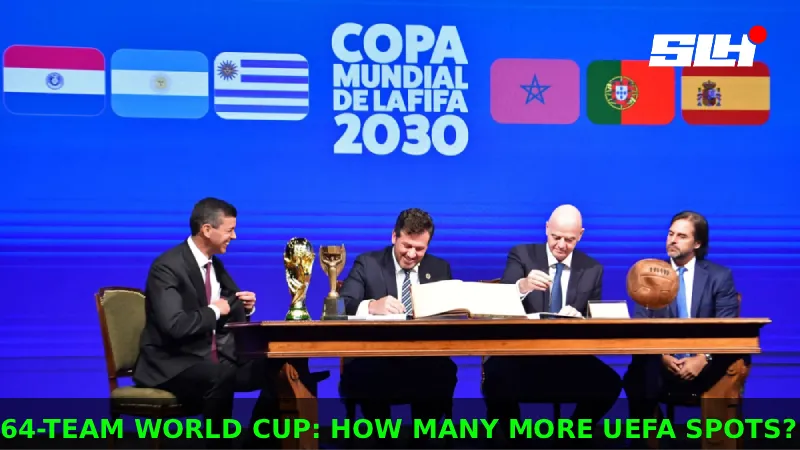


A 64-team World Cup would hand European nations roughly 22 automatic slots instead of today’s 16, softening a qualification rate that currently sits near 29 per cent for UEFA’s 55 members. CONMEBOL president Alejandro Dominguez proposed the expansion in April 2025 as a one-off tribute to the tournament’s centenary, but UEFA chief Aleksander Ceferin has already called the idea harmful to both the finals and European qualifying itself. The AFC and CONCACAF have joined UEFA in opposition, leaving FIFA president Gianni Infantino describing the format as still under consideration.
Dominguez formally floated the 64-team concept for 2030 in April 2025, framing it as a tribute to the tournament’s hundredth anniversary rather than a lasting overhaul. The idea reportedly surfaced earlier still, raised at a FIFA Council meeting in March 2025 by Ignacio Alonso, president of the Uruguayan Football Association.
By the time the 2026 tournament kicked off, UEFA, the AFC and CONCACAF had all spoken out against the plan. Infantino kept the door open regardless, calling the concept still under consideration rather than dead on arrival.
Comparing current and proposed totals confederation by confederation shows what’s on the table. UEFA currently holds 16 of the 48 available places, a figure that could rise toward 22 under a proportional 64-team split.
| Confederation | Current Slots (48 teams) | Potential Slots Under 64 Teams |
| UEFA (Europe) | 16 | ~22 (est.), about 40% of 55 members |
| CAF (Africa) | 9 | ~13 (est.) |
| AFC (Asia) | 8 + play-in | ~12 (est.) |
| CONMEBOL (South America) | 6 + play-in | 10 (all 10 members, CONMEBOL motive) |
| CONCACAF (N/C America) | 6 + play-in | ~9 (est.) |
| OFC (Oceania) | 1 (play-in) | ~2 (est.) |
These 64-team figures remain estimates, since no official allocation formula has been proposed; only the 48-team totals confirmed for 2026 are locked in. CONMEBOL’s ambition stands out in that final column, where a proportional split would hand all 10 of its members automatic places.
Ceferin’s objection runs deeper than dismissing the format outright. He frames it as a direct threat to what European qualifying means, not just a debate about tournament size. Under the current 48-team setup, UEFA’s 16 slots from 55 members create a qualification rate of just 29 per cent, keeping most groups tense deep into the campaign.
A proportional jump to 64 teams would push that figure toward 40 per cent, loosening the pressure that gives qualifiers their edge. Fewer nations eliminated means fewer nights that matter, and Ceferin is betting a softer path would blunt both the sporting and commercial value of Europe’s route to the finals.
Venezuela remains the only CONMEBOL nation that has never reached a World Cup, and that detail explains the federation’s enthusiasm better than any public statement from Dominguez. Guaranteeing places for all 10 South American associations turns the centenary proposal into a safety net for a confederation that already qualifies at a strong clip.
For UEFA, the calculation cuts the opposite way. Loosening qualification would blunt competitive intensity in the region that generates the largest share of FIFA’s commercial revenue, even as it locks in a guaranteed outcome for every CONMEBOL member.
AFC president Sheikh Salman raised a slippery-slope warning, suggesting that once the format is treated as negotiable, someone could eventually push for 132 teams. CONCACAF’s Victor Montagliani took a procedural line, noting the newly expanded 48-team World Cup hadn’t even kicked off before the 64-team idea surfaced. Three of the five major confederations now stand publicly opposed, leaving CONMEBOL isolated in pressing the case.
Expanding the format again isn’t something FIFA can simply announce from a boardroom. The move from 32 to 48 teams required a unanimous Congress vote in January 2017, and any leap to 64 teams would need that same mechanism. FIFA’s 75th Congress is scheduled for Paraguay on May 15, 2026, giving the proposal a formal stage.
With UEFA, AFC and CONCACAF already opposed, reaching the required supermajority looks unlikely at any congress in the near term. Weighing a rise from 16 to roughly 22 slots against the loss of competitive tension captures the 64-team World Cup European qualification impact that continues to worry European administrators.
Do you think a 64-team World Cup is worth trading away the tension of European qualifying, or should FIFA leave the 48-team format alone? Tell us your take in the comments.
As football fans globally search for the most reliable platforms to witness history unfold—especially with Argentina currently attempting to join this exclusive list in the 2026 World Cup Final—Sports Live Hub (SLH) emerges as the ultimate destination for premium sports broadcasting.
Finding a secure, uninterrupted broadcast during major international tournaments can be incredibly frustrating due to complex regional restrictions and geo-blocks. The hub sports live stream feature available on SLH operates as a state-of-the-art intelligent aggregator. It seamlessly maps your location and automatically routes you to verified, official regional broadcast feeds. This ensures that fans can watch every crucial moment of the World Cup in stunning high-definition, completely free from the irritating buffering issues and dangerous malware threats associated with illegal, unverified streaming websites.
Modern football enthusiasts demand a highly analytical and interactive viewing experience. The sport hub live streaming interface on SLH serves as an elite second-screen companion for dedicated fans. As you watch the world’s best teams compete for international glory, the platform provides dynamic, real-time digital overlays. Viewers gain instant access to advanced tactical data, including live Expected Goals (xG), detailed passing networks, and comprehensive player heatmaps, empowering them to dissect the beautiful game just like a professional television pundit.
During monumental events like a World Cup Final, internet searches for how to watch Sports live for free inevitably skyrocket. SLH proactively solves this challenge by maintaining a meticulously curated, fully localized directory of legal, free-to-air (FTA) broadcasting networks. By specifically highlighting public broadcasters that legally air these premium matches without requiring expensive subscription paywalls, SLH guarantees that the unparalleled excitement of international football remains completely accessible, safe, and entirely legal for millions of passionate fans worldwide.
Why does UEFA oppose a 64-team World Cup?
Ceferin considers it damaging to both the quality of the tournament and the meaning of European qualifying. Roughly 40 per cent of UEFA’s 55 members would qualify under the new format, compared with 29 per cent today.
When would a 64-team World Cup take effect?
No format change has been approved, and the 2030 tournament remains set at 48 teams for now. CONMEBOL pitched the expansion strictly as a one-off centenary gesture tied specifically to 2030.
Who proposed the 64-team World Cup for 2030?
CONMEBOL president Alejandro Dominguez formally floated the idea in April 2025. It had first surfaced weeks earlier when Uruguayan Football Association president Ignacio Alonso raised it at a FIFA Council meeting in March 2025.
How many teams qualified for the 2026 World Cup?
The 2026 tournament is the first edition to use a 48-team format. UEFA received 16 of those slots, with matches hosted across the United States, Canada and Mexico.
Does FIFA need approval to expand the World Cup again?
Yes, any format change requires a unanimous FIFA Congress vote to pass. The 2017 Congress approved the shift from 32 to 48 teams unanimously, and UEFA, the AFC and CONCACAF already oppose a further expansion.
 football
 cricket
 football