


Opinions, analysis and commentary
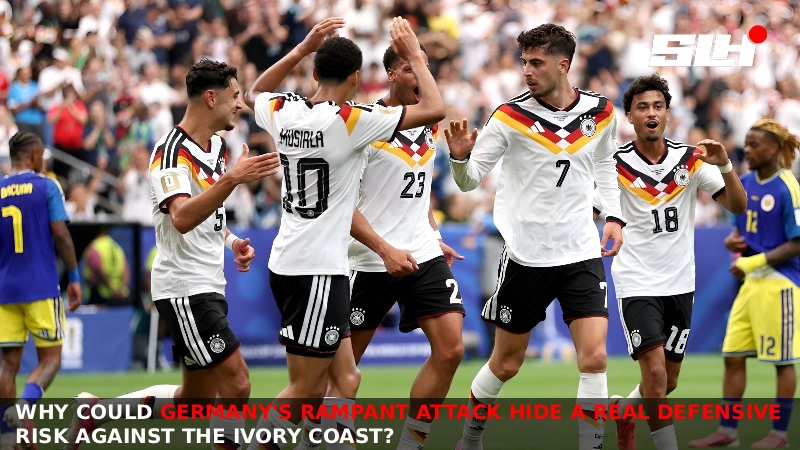


Germany’s 7-1 win over Curaçao flattered a defence that hasn’t actually been tested yet. Twenty-six shots and 57 percent possession against a World Cup debutant tell you almost nothing about how that backline copes with real pace. The same gap behind Kimmich’s advancing right-back position that Mexico and Algeria once exploited at major tournaments is still there, and the Ivory Coast has the runners to find it. Whether Nagelsmann tightens that channel or trusts his midfield to cover it could decide Group E before the final group game.
Germany scored seven without much real examination, beating Curaçao 7-1 in their Group E opener on June 14. Nmecha, Schlotterbeck, two from Havertz, Musiala, Brown, and Undav did the damage at Houston Stadium, with Nagelsmann’s side overcoming only a brief, nervy spell before taking total control of a side making its first-ever World Cup appearance.
| Stat | Germany | Curaçao |
| Goals | 7 | 1 |
| Shots | 26 | 8 |
| Possession | 57% | 43% |
The shot count tells the real story. Holding more than half of possession and out-shooting a side playing its first ever World Cup match by that margin says little about how the back line holds up against pace and direct running.
Nagelsmann’s 4-2-3-1 leans on Joshua Kimmich inverting from right-back into a midfield three during build-up, a swap that frees Wirtz and Musiala to operate as interior creators rather than out wide. It also leaves the right-back channel open the moment Kimmich steps inside, exactly the space Ivory Coast’s wide players want to attack on the left flank.
Germany’s full-backs push high, and the front line interchanges freely when things go to plan, which is precisely why the space behind those advancing full-backs becomes the single biggest structural risk heading into Toronto. Nagelsmann has the option of switching to a back three if the gap proves too costly.
This isn’t theoretical. At the 2018 World Cup, Mexico exploited the high positioning of full-backs Plattenhardt and Kimmich, springing Hirving Lozano clear with two quick passes for the only goal of the game, with Lozano given all the time he needed to set himself and beat Manuel Neuer.
Even during the 2014 title run, Algeria’s counter-attacks repeatedly exposed the same high line, forcing Neuer into sweeper-keeper duties just to keep the scoreline level in the round of 16. Whenever an opponent has genuine pace to attack that space, Germany have been made to suffer for it at the biggest tournaments.
Yan Diomande was Ivory Coast’s standout player in their 1-0 opening win over Ecuador, repeatedly stretching the defensive line and creating transition problems all afternoon for the RB Leipzig winger. Kimmich himself has already flagged the danger, calling Diomande’s dribbling “exceptional, a bit like Kingsley Coman” at Bayern.
Amad Diallo scored a 90th-minute winner off the bench against Ecuador, a first-time finish from Wilfried Zaha’s pass that ended Ecuador’s 19-game unbeaten run, after a season that produced 8 goals and 6 assists in 26 Premier League appearances for Manchester United.
Elye Wahi adds the pace in behind, striking the crossbar against Ecuador and averaging more than 2.5 shots per 90 minutes across his Ligue 1 campaign for Nice. His movement, combined with Diomande’s driving runs from wide, gives Ivory Coast more than one route into the same space behind Germany’s back line.
Ivory Coast made 36 right-channel entries into the final third against Ecuador, a clear directional pattern that lines up with exactly where Kimmich vacates when he tucks inside. Their compact mid-block is built to invite Germany onto the ball before springing the counter through that same channel, repeatedly if it keeps working.
Nagelsmann’s choice is straightforward in theory and difficult in practice: ask Kimmich to be more disciplined about recovery runs and blunt his own midfield overload, or trust Pavlovic and Goretzka’s double pivot to screen the gap and accept the risk. Get it wrong, and Toronto could produce the kind of moment that follows Germany into the knockout rounds. The Germany defense FIFA World Cup 2026 risk question won’t be settled by a 7-1 scoreline against a debutant side; it will be settled by how this specific matchup actually plays out, with a final group game against Ecuador still to come on June 25.
Stay updated on every twist and turn of the summer transfer window and catch all the live football action with Sports Live Hub (SLH).
Accessing a high-quality hub sports live stream is essential for fans following the matches of the World Cup season. SLH provides a verified directory of official broadcasting partners, ensuring you never miss a moment of the action from the Premier League or Liga Portugal or World Cup.
Our sport hub live streaming dashboard offers real-time tactical overlays, player fitness stats, and live transfer probability tickers. As the WC 2026 saga develops, SLH is the destination for integrated sports data and high-definition viewing.
If you are wondering how to watch Sports live for free, SLH maintains a curated list of official free-to-air (FTA) broadcasters and legitimate digital promotional windows. We help fans find legal, cost-free ways to enjoy global sports while ensuring safety from unauthorized streaming sites.
How did Germany beat Curaçao 7-1?
Germany scored through six different players against Curaçao, including a Havertz brace. Nmecha opened the scoring in the sixth minute before Schlotterbeck, Musiala, Brown, Undav, and a second Havertz goal completed the rout.
What formation does Germany play under Nagelsmann?
Germany lined up in a 4-2-3-1 under Julian Nagelsmann, with the option to switch to a back three. Kimmich starts at right-back but regularly inverts into midfield during build-up play.
Who are the Ivory Coast’s fastest attacking players?
Yan Diomande, Amad Diallo, and Elye Wahi lead the Ivory Coast’s pace in transition. All three play for major European clubs and have already shown they can hurt defenses on the counter.
Has Germany’s defense been exposed before at a World Cup?
Yes, Mexico exploited Germany’s high line in 2018 through Hirving Lozano’s winning goal. Algeria caused similar problems in the 2014 round of 16 by attacking the same space behind the full-backs.
What does Germany need to win Group E?
A win or a draw against the Ivory Coast would secure Group E for Germany before their final game. That final fixture comes against Ecuador on June 25.
 football
 football
 cricket