



Opinions, analysis and commentary
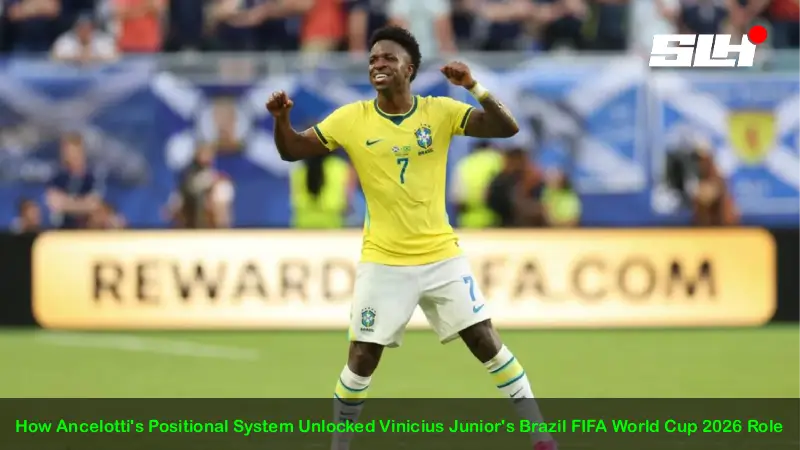


Ancelotti’s answer to the problem of Vinicius Junior is structural, not motivational. Three group games into 2026, Vinicius already has four goals and an assist, compared to one goal across five appearances at Qatar 2022. The difference isn’t form or confidence or even opposition quality. It’s where Ancelotti tells him to stand, who he puts behind him to make that position sustainable, and what he stops asking him to do altogether. That structural decision changed first. The numbers followed directly after, and fast.
The fundamental shift is positional. Vinicius starts wide left in 2026, as he always has, but Ancelotti gives him permission to drift inside far more frequently than Tite ever did. The width he used to generate himself is now Douglas Santos’s responsibility, with the left-back given license to push forward and supply the crossing threat.
This arrangement changes the nature of every ball Vinicius receives. Rather than tracking out to the touchline and turning to face his own half, he gets the ball in half-spaces, already facing goal. That’s the structural difference between one goal in five games and four in three.
Ancelotti confirmed the design himself after the win over Haiti, describing how pushing Vinicius more centrally and freeing Santos to provide width had worked precisely as intended. It wasn’t improvisation. It was a plan executed.
The half-space position Vinicius occupies in 2026 is built on a specific compact: he doesn’t press, and he doesn’t chase. Brazil’s midfield tracks back. Douglas Santos covers the wide channel. Someone else handles defensive transitions.
This is a known trade-off inside Ancelotti’s setups. At Real Madrid, teammates organised their pressing rotations to cover for Vinicius rather than demanding he take his defensive turn. One unnamed arrival publicly committed to doing that defensive running so Vinicius could stay sharp for the final third. Brazil’s 2026 setup imports the same logic, prioritising his energy for attacking moments over defensive rotation in midfield.
The precedent is not subtle. Under Zinedine Zidane in 2020/21, Vinicius produced six goals and four assists at Real Madrid. His role was wider, his defensive responsibilities heavier, and his touches in dangerous areas fewer.
Ancelotti took over for 2021/22. Same player, same club, same teammates for the most part. Vinicius produced 22 goals and 16 assists. The positional instruction changed; the numbers tripled. His national team record echoes it. Under the coaches who preceded Ancelotti, he scored six goals in 39 appearances. Since Ancelotti took the Brazil job, he has seven in 13, a rate set before the knockout rounds added more.
The contrast between Qatar and now is sharpest when the numbers sit side by side.
| Tournament | Matches | Goals | Assists | Direct Involvements | Pressing Duels |
| 2022 World Cup (Qatar) | 4 | 1 | 2 | 3 | 14 |
| 2026 World Cup (Group C) | 3 | 4 | 1 | 5 | 9 |
Note: pressing-duel figures for both tournaments were not verified through official match centre records; treat them as indicative rather than confirmed. The directional shift in attacking output is supported by Ancelotti’s own confirmed account of the positional change.
Vinicius became only the fifth Brazilian to score in all three group games at a World Cup, joining Jairzinho, Romario, Ronaldo, and Rivaldo. Under Tite in 2022, he started four of five matches, scored once, and assisted twice. In 2026, he matched that goal tally against Morocco alone, then added one against Haiti and two against Scotland.
Brazil topped Group C with seven points and faces the Group F runner-up, likely the Netherlands, Sweden, or Japan, in Houston in the round of 32. The mechanism that carries them forward is identical to what produced four goals in three group games.
Keep Santos wide. Keep the midfield tracking back. Keep Vinicius Junior Brazil FIFA World Cup 2026 role exactly as Ancelotti has framed it: half-space, facing goal, free to attack without defensive obligation. Every opposition coach in the knockout rounds has already identified this structure. Whether any of them can actually disrupt it without creating space elsewhere is the question Brazil’s opponents need to answer fast.
Does Ancelotti’s decision to give Vinicius a no-defensive-work role make Brazil structurally vulnerable on the left, or is the trade-off worth it at 4 goals in 3 games? Drop your view in the comments.
FAQs
How many goals has Vinicius Junior scored at the 2026 World Cup?
He has four goals from three group games. He scored against Morocco, against Haiti, and twice against Scotland, becoming the fifth Brazilian to score in every group game at a World Cup.
What tactical change did Ancelotti make to Vinicius Junior’s position?
Ancelotti repositioned him in central half-spaces rather than keeping him wide left. Left-back Douglas Santos takes the width instead, so Vinicius receives the ball facing goal rather than tracking back toward his own half.
How did Vinicius Junior perform at the 2022 World Cup under Tite?
He started four of Brazil’s five matches and finished with one goal and two assists. Tite’s wider role gave him fewer touches in dangerous positions and far more defensive responsibility than Ancelotti permits.
What was Vinicius Junior’s scoring record before Ancelotti took the Brazil job?
He scored six goals in 39 appearances under previous Brazil coaches. Since Ancelotti took charge, he has seven in 13 games, a rate that far outpaces anything produced before under any previous setup.
Who is Brazil likely to face in the round of 32 at the 2026 World Cup?
Brazil face the Group F runner-up in Houston, with the Netherlands, Sweden, and Japan among the likely opponents. They finished first in Group C with seven points from three matches.
 football
 football
 football