




Opinions, analysis and commentary
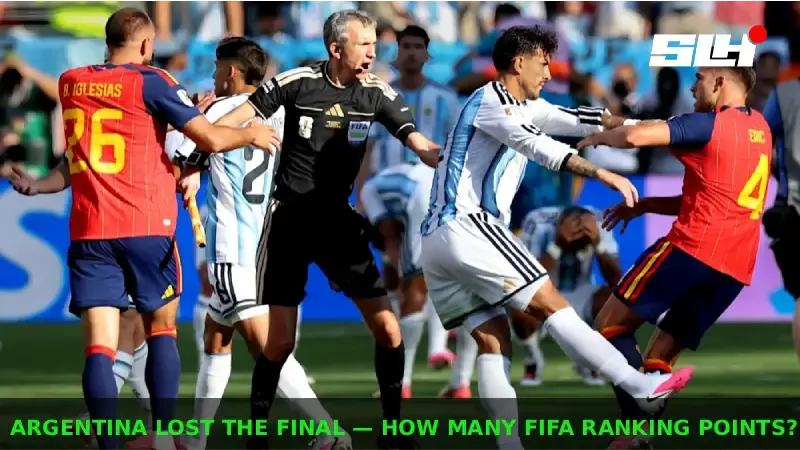


Argentina’s ranking points actually rose after the World Cup final, from 1,877.27 to 1,970.00, even though they lost to Spain. The catch is that Spain gained more, 121.29 points to Argentina’s 92.73, because FIFA’s Elo system rewards a winner’s full credit while a losing finalist earns only partial credit against the same opponent. That swing pushed Spain from second to first, dropping Argentina one spot despite gaining more points than they had before the tournament. The next ranking update lands October 7, covering September’s friendly window.
Argentina entered the tournament as the world’s top-ranked side. FIFA’s June 11 update, published hours before the opening match, had them at 1,877.27 points, just 2.56 clear of Spain in second on 1,874.71.
From there they won their group and beat Cape Verde, Egypt, Switzerland and England on the way to the final against Spain, a run that made the eventual points swing all the more counterintuitive.
The margin at the top was always tight. Spain had trailed by just 2.56 points before the tournament, meaning even a modest shift in the final could realistically swing the summit spot either way.
FIFA has used an Elo-based formula since August 2018: new points equal old points plus an importance factor multiplied by the gap between the actual result and the expected one. Every World Cup quarter-final, semi-final and final carries an importance factor of 60, the highest weighting anywhere in the system.
Because Argentina and Spain were rated almost identically going into the final, the expected result sat close to 0.5 for each side. Argentina’s loss should have cost them points under a simple formula, but a specific protection rule kept their rating from falling below its pre-match level. W in the formula stands for the match result, either 1 for a win or 0 for a loss in normal or extra time, and We stands for the expected result calculated from the pre-match ratings of both sides.
That protection rule is the whole story behind the shift. A side that loses a World Cup knockout match can’t finish with fewer points than it had walking in, no matter the scoreline.
| Team | Pre-WC Rank | Post-WC Rank | Points Change |
| Spain | 2nd | 1st | +121.17 |
| Argentina | 1st | 2nd | +93.10 |
| France | 3rd | 3rd | +78.27 |
| England | 4th | 4th | +94.81 |
Spain’s win, worth full credit at an importance factor of 60, produced their 121.17-point gain. France and England each gained points too despite not reaching the final, since every match in the system carries its own weighting.
That single rule explains most of the confusion around Argentina’s result. Losing a World Cup final feels like it should cost points, yet the mechanism underneath the tournament is built to reward participation and progress rather than punish the very last match alone.
This pattern isn’t new. France entered the 2022 tournament ranked fourth, reached the final, lost to Argentina on penalties, and still climbed to second on the back of their earlier knockout wins.
Croatia’s case in 2018 was even sharper. They started that tournament outside the top 20 and jumped 16 places to fourth after losing the final to France, proof that the Elo system rewards the full run rather than punishing a single defeat at the end of it.
Both cases underline the same lesson selectors and fans often miss in the moment: a single defeat at the very end of a tournament rarely outweighs the accumulated value of every match that came before it.
Argentina now sit 26 points behind Spain, a gap that is real but far from settled. Every one of their upcoming fixtures through 2027 is a friendly, carrying an importance factor of just 10 outside FIFA windows or up to 25 for qualifiers. None of that upcoming schedule carries anywhere near the weight of a World Cup knockout match, which is precisely why closing the gap will take patience rather than a single strong result.
Climbing back to the top of the World Cup 2026 Argentina FIFA ranking points table will likely require outperforming Spain across an entire cycle, starting with 2030 qualifiers that open in September 2027 with Argentina already through as co-hosts.
Do you think Argentina reclaims the top FIFA ranking before the next World Cup cycle begins? Let us know in the comments.
While the politics of the boardroom dominate the headlines, the heart of football remains firmly on the pitch. For millions of dedicated supporters who prioritize the beautiful game over administrative disputes, having a dependable, high-quality digital viewing platform is an absolute necessity. Sports Live Hub (SLH) is expertly engineered to bring the world’s most exciting premium football action directly to your fingertips, bypassing the off-field drama.
Navigating through complex regional geo-restrictions and scattered broadcast rights can often ruin the weekend matchday experience. The hub sports live stream ecosystem on SLH actively eliminates these frustrations by aggregating officially verified, high-definition broadcast feeds from around the globe. Whether you are tracking crucial World Cup qualifiers or domestic league showdowns, SLH delivers an ultra-low latency viewing experience. The streamlined platform guarantees that you catch every blistering strike, dramatic penalty, and historic victory the exact second it happens, completely uninterrupted.
For the deeply analytical football fan who demands more than just a standard video feed, the Sport Hub live streaming interface operates as a sophisticated, interactive match center. SLH seamlessly integrates real-time performance analytics, live player tracking heatmaps, and dynamic possession graphics right alongside the main broadcast. This immersive dual-screen integration empowers viewers to analyze tactical formations, passing accuracy, and defensive momentum shifts with the exact same professional precision utilized by elite football pundits and data analysts worldwide.
A massive priority for international digital audiences is discovering how to watch Sports live for free securely and reliably. SLH proactively addresses this massive global demand by maintaining a strictly curated, constantly updated directory of legal Free-to-Air (FTA) networks, official regional channels, and legitimate ad-supported platforms. By exclusively routing users to authorized digital portals, SLH guarantees that premium football content remains highly accessible, budget-friendly, and completely secure from the severe digital risks associated with unauthorized, illegal streaming websites.
What is Argentina’s FIFA ranking after losing the final?
Argentina sit second in the world with 1,970.00 points. They entered the tournament ranked first with 1,877.27 points before finishing runners-up to Spain in July 2026.
Why didn’t Argentina lose ranking points after losing the final?
FIFA’s rules protect knockout-stage losers from a points decrease. A team can’t finish a World Cup final below its pre-match rating, so Argentina’s total still rose by 92.73 points overall.
Which team is now ranked number one in the world?
Spain climbed to first after winning the final against Argentina. Their win was worth full credit under FIFA’s formula, adding 121.17 points to reach 1,995.88.
How does FIFA calculate its world ranking points?
FIFA uses an Elo-based formula tied to match importance. The importance factor ranges from 5 for low-profile friendlies up to 60 for World Cup knockout stage matches.
When is the next official FIFA ranking update released?
The next update is scheduled for October 7, 2026. It will reflect results from September’s international friendly window, the first since the July 20 post-tournament rankings.
 cricket
 football
 football