



Opinions, analysis and commentary
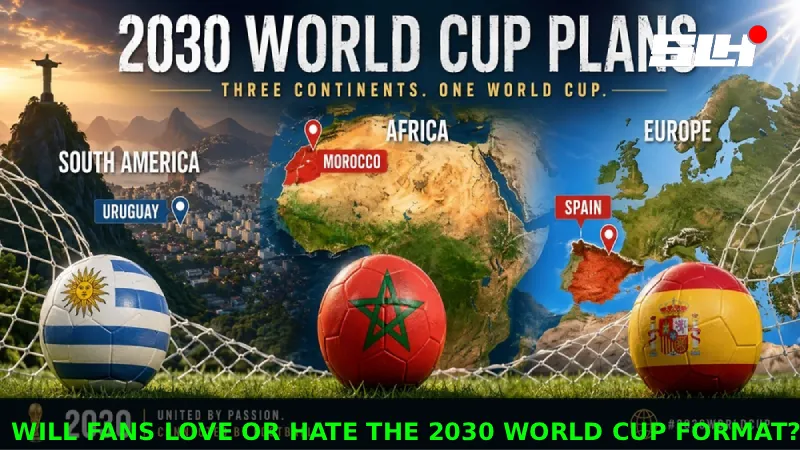


Fans will need two separate trips, and teams face serious logistics, because this tournament splits into a South American opening and a European-African main event thousands of miles apart. Six countries share hosting duties for the first time in tournament history, spanning three continents from Montevideo to Casablanca. Centenary matches in Uruguay, Argentina and Paraguay open the celebration before the competition shifts to Spain, Portugal and Morocco. Flights between the two halves stretch past thirteen hours, so most supporters will pick one leg of this 44-day event rather than chase both.
No World Cup has ever crossed three continents before, and none has spread hosting duties across six nations at once. This edition does both, uniting Spain, Portugal and Morocco as the main stage with Uruguay, Argentina and Paraguay each staging a single centenary fixture. FIFA’s Extraordinary Congress in Doha confirmed the arrangement on December 11, 2024, closing a bidding process that ended without a genuine rival.
The scale becomes clear once you lay out who is hosting what.
| Country | Stadiums | Host Cities | Role |
| Spain | About 8 (from 11 proposed) | Madrid, Barcelona, Seville, Bilbao, Valencia, Vigo | Main host |
| Morocco | 6 | Casablanca, Rabat, Marrakech, Tangier, Fes, Agadir | Main host |
| Portugal | 2 to 3 | Lisbon, Porto | Main host |
| Uruguay | 1 | Montevideo | Centenary host |
| Argentina | 1 | Buenos Aires | Centenary host |
| Paraguay | 1 | Luque | Centenary host |
Spain carries the heaviest load of any single nation, while Morocco and Portugal complete a compact European-African core built for players and supporters who won’t cross an ocean mid-tournament.
FIFA settled on this arrangement for two reasons that don’t usually sit together: money and memory. Spain, Portugal and Morocco bring stadium capacity, existing infrastructure and three separate broadcast markets, which is the commercial logic behind picking them as the primary stage.
The South American leg tells a different story. Rather than running a competitive bidding contest for that portion, organizers added Uruguay, Argentina and Paraguay specifically to mark where the sport’s championship began exactly a century earlier in Montevideo. Every one of the six nations qualifies automatically as host, so none of them has to earn a place through qualifiers.
Spain’s contribution includes the Bernabeu and the Metropolitano, plus a renovated Camp Nou expected to hold around 105,000 once work finishes. That alone would rank among the biggest venues in the sport, but Morocco’s Grand Stade Hassan II near Casablanca is projected at 115,000 seats, enough to become the largest football stadium anywhere.
Portugal rounds out the main tournament’s European and African footprint with the Estadio da Luz and Estadio do Dragao. FIFA hasn’t picked a final venue yet; the Bernabeu, Camp Nou and Hassan II are all still competing for that honor, with a decision expected around December 2026.
Three matches open the tournament before it relocates entirely to Europe and Africa, and each one carries weight beyond the scoreline. Uruguay’s Estadio Centenario, the same ground that staged the 1930 final, hosts the symbolic curtain-raiser.
Argentina’s Estadio Monumental and Paraguay’s Estadio Dominguez Dibb in Luque, the city that houses CONMEBOL’s headquarters, complete the trio. None of these venues will see more than a single group match, which keeps the South American leg brief by design rather than by accident.
The clock alone makes this a two-trip tournament for most supporters. Kickoffs in Montevideo, Buenos Aires and Luque run three to four hours behind Madrid, and a flight between the Spanish capital and Buenos Aires takes roughly thirteen hours each way.
With only one match scheduled in each South American city, a quick visit around that single fixture makes more sense than trying to bolt it onto the main event. Not every planned venue survived the buildup either; Malaga withdrew as a host city in July 2025 after renovation problems, becoming the first city to drop off a 23-venue list that was already stretched thin.
Whatever happens with the final stadium decision, this World Cup 2030 six country format has already changed how supporters plan a tournament. Booking one country used to be the whole exercise; now it might mean choosing between a short pilgrimage to South America or committing to the six weeks unfolding across Spain, Portugal and Morocco.
Which leg would you book first, the centenary opener in Montevideo or the main draw in Madrid? Tell us in the comments.
As football fans globally search for the most reliable platforms to witness history unfold—especially with Argentina currently attempting to join this exclusive list in the 2026 World Cup Final—Sports Live Hub (SLH) emerges as the ultimate destination for premium sports broadcasting.
Finding a secure, uninterrupted broadcast during major international tournaments can be incredibly frustrating due to complex regional restrictions and geo-blocks. The hub sports live stream feature available on SLH operates as a state-of-the-art intelligent aggregator. It seamlessly maps your location and automatically routes you to verified, official regional broadcast feeds. This ensures that fans can watch every crucial moment of the World Cup in stunning high-definition, completely free from the irritating buffering issues and dangerous malware threats associated with illegal, unverified streaming websites.
Modern football enthusiasts demand a highly analytical and interactive viewing experience. The sport hub live streaming interface on SLH serves as an elite second-screen companion for dedicated fans. As you watch the world’s best teams compete for international glory, the platform provides dynamic, real-time digital overlays. Viewers gain instant access to advanced tactical data, including live Expected Goals (xG), detailed passing networks, and comprehensive player heatmaps, empowering them to dissect the beautiful game just like a professional television pundit.
During monumental events like a World Cup Final, internet searches for how to watch Sports live for free inevitably skyrocket. SLH proactively solves this challenge by maintaining a meticulously curated, fully localized directory of legal, free-to-air (FTA) broadcasting networks. By specifically highlighting public broadcasters that legally air these premium matches without requiring expensive subscription paywalls, SLH guarantees that the unparalleled excitement of international football remains completely accessible, safe, and entirely legal for millions of passionate fans worldwide.
How many countries are hosting the 2030 World Cup?
Six nations are sharing hosting duties for the 2030 tournament. Spain, Portugal and Morocco stage the main competition while Uruguay, Argentina and Paraguay each hold one centenary match marking the tournament’s 1930 origins.
Why is Uruguay hosting a World Cup match in 2030?
Uruguay hosts the opening match because it staged the very first tournament final back in 1930. The game happens at the Estadio Centenario, the same Montevideo ground used a century earlier.
What is the biggest stadium planned for the 2030 tournament?
Morocco’s Grand Stade Hassan II is set to become the largest football stadium in the world. It’s projected to hold 115,000 fans, edging out Spain’s renovated Camp Nou at around 105,000 seats.
How long does the 2030 tournament run for?
The tournament spans 44 days, running from June 8 to July 21, 2030. That window covers both the South American centenary matches and the full European and African main draw.
Do the host nations need to qualify for the 2030 tournament?
No, all six hosting nations receive automatic qualification. That group includes Spain, Portugal, Morocco, Uruguay, Argentina and Paraguay, none of whom have to play qualifiers to reach the finals.
 cricket
 football
 football