




Opinions, analysis and commentary
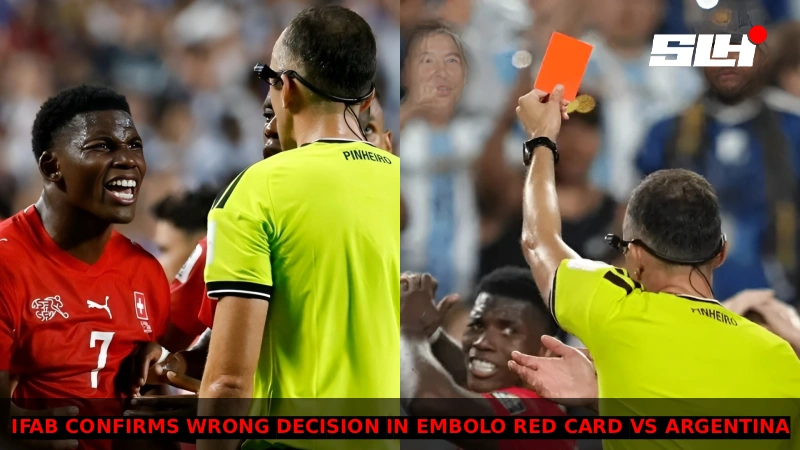


The International Football Association Board (IFAB), football’s ultimate law-making body, has officially acknowledged a significant officiating error that occurred during the 2026 FIFA World Cup. In a recently published circular, IFAB confirmed that Switzerland forward Breel Embolo was incorrectly sent off during his team’s crucial quarter-final clash against Argentina. The controversial decision, which drastically altered the momentum of the match, has sparked widespread debate regarding the application of Video Assistant Referee (VAR) protocols.
The match, held in Kansas City on July 11, saw Switzerland eventually lose 3-1 in extra time after being reduced to ten men. This official admission by IFAB vindicates the heavy criticism directed at the match officials by the Swiss camp immediately following their elimination. As football fans and pundits analyze the implications of this ruling for future tournaments, this comprehensive overview breaks down the incident, the specific rule misapplied, and what it means for the future of VAR.
The contentious moment unfolded in the 27th minute of the second half, with the quarter-final delicately poised at 1-1. Swiss striker Breel Embolo went down near the penalty area following a challenge from Argentina midfielder Leandro Paredes. Initially, Portuguese referee Joao Pinheiro awarded a foul and brandished a yellow card to Paredes.
However, the VAR room quickly intervened, prompting Pinheiro to review the incident on the pitchside monitor. Following the review, the referee took unprecedented action: he canceled the yellow card for Paredes, determining no foul had occurred, and instead booked Embolo for simulation (diving). Because Embolo had already received a yellow card earlier in the match, this second caution resulted in a red card, dismissing him from the game.
IFAB’s recent circular clarifies that the VAR intervention overstepped its jurisdictional authority under the current Laws of the Game. The core issue revolves around the “mistaken identity” provision. According to IFAB’s strict protocols, “a yellow card—other than a second yellow card—can only be reviewed to identify the player who committed the offence; the offence itself cannot be reviewed or modified”.
Essentially, VAR can only step in if the referee accidentally books the wrong player for a foul. It cannot be used to re-evaluate the nature of the incident and change a foul into a simulation by a completely different player. Because there was no mistake regarding the identity of the players involved in the initial challenge, VAR had no authority to recommend reversing the decision to penalize Embolo for a dive. The dismissal forced Switzerland to play with a numerical disadvantage, eventually conceding two goals in extra time to the eventual runners-up, Argentina.
| Incident Parameter | Details & IFAB Clarification |
| Match | Argentina vs. Switzerland (2026 World Cup Quarter-Final) |
| Players Involved | Breel Embolo (SUI) & Leandro Paredes (ARG) |
| Referee | Joao Pinheiro (Portugal) |
| Initial Decision | Foul by Paredes; Yellow Card to Paredes |
| VAR Intervention Result | Paredes Yellow canceled; Embolo booked for simulation (2nd Yellow = Red Card) |
| IFAB Ruling | Incorrect Decision; VAR overstepped authority |
| Core Rule Violated | VAR cannot review/modify a standard yellow card offense, only correct mistaken identity |
In an era where every refereeing decision is scrutinized, and matches are decided by the slimmest of margins, having access to reliable, high-quality sports broadcasting is non-negotiable. Sports Live Hub (SLH) is the ultimate digital platform for football fans who demand seamless streaming, real-time analytics, and comprehensive match coverage.
Navigating through geo-restrictions and fragmented broadcasting rights can be a major hurdle for international football fans. The hub sports live stream feature on SLH eliminates these barriers. Acting as a premium streaming aggregator, SLH automatically connects users to the most stable, officially verified broadcast feeds in their region. This ensures you catch every crucial moment, from spectacular goals to controversial VAR reviews, in ultra-high definition without the frustration of buffering or malicious pop-ups.
The modern football spectator requires more than just a standard video feed. The sport hub live streaming interface on SLH serves as a sophisticated second-screen experience. While you watch the live action, the SLH platform delivers integrated, professional-grade analytics directly to your device. Fans can instantly access live player heatmaps, dynamic passing networks, real-time VAR decision explanations, and predictive win probability charts, allowing for a deeper tactical understanding of the game as it unfolds.
A frequent question during major tournaments like the World Cup is how to watch Sports live for free securely. SLH proactively addresses this massive consumer demand by maintaining an updated, localized directory of legal, free-to-air (FTA) broadcasting networks globally. By highlighting official public channels and verified ad-supported platforms, SLH ensures that premium international football action remains highly accessible, entirely legal, and completely secure for fans everywhere.
IFAB stated that the VAR intervention was incorrect because VAR is only allowed to review a standard yellow card in cases of mistaken identity, not to re-evaluate the offense itself and change a foul into a simulation.
The match was officiated by Portuguese referee Joao Pinheiro, who initially booked Argentina’s Leandro Paredes before VAR intervened.
Argentina defeated Switzerland 3-1 after extra time to advance to the semi-finals of the 2026 World Cup.
Under current IFAB protocols, VAR cannot intervene to award a yellow card for simulation unless it is directly tied to a penalty kick review or a straight red card incident. It cannot change a standard foul decision into a simulation yellow card.
Football fans can utilize the Sports Live Hub (SLH) platform to access officially verified regional broadcasts, legal free-to-air (FTA) streaming directories, and real-time match analytics.
 football
 football
 cricket