

Opinions, analysis and commentary
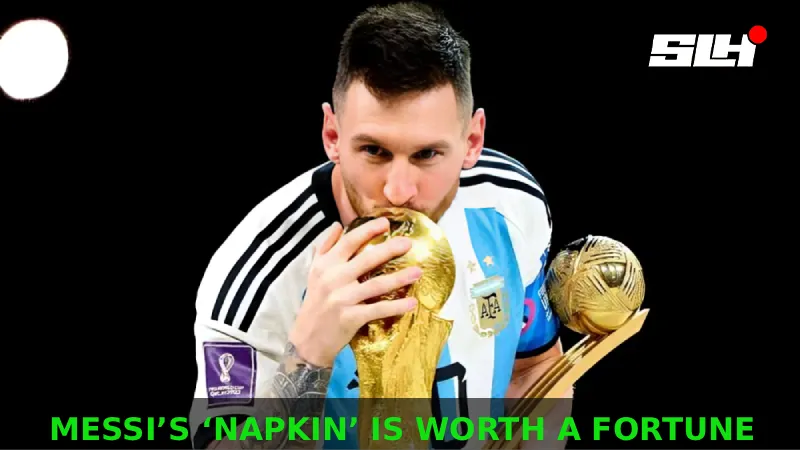


A napkin outsells match-worn boots and jerseys because collectors aren’t really buying sporting performance; they’re buying the one document that can never be repeated. In May 2024, a blank restaurant napkin carrying Barcelona sporting director Carles Rexach’s handwritten commitment to sign a 13-year-old Lionel Messi sold at auction for nearly a million dollars, comfortably beating several genuine game-worn items from his career. The reason comes down to scarcity and story, not sweat, and it says something about how the collector market has changed.
On December 14, 2000, Rexach asked a waiter for paper and was handed a blank napkin instead. Under pressure from Jorge Messi, who had threatened to take his son back to Argentina if Barcelona didn’t commit on the spot, Rexach wrote his promise in blue ink and signed it alongside Argentine agent Horacio Gaggioli and fellow agent Josep Maria Minguella. The 6.5 x 6.5 inch napkin, written in blue ink on the spot, became the starting point of one of sport’s greatest careers.
In May 2024, Bonhams auctioned the napkin in London on Gaggioli’s behalf. A flurry of bids in the final half hour pushed the price past its £300,000 starting estimate, and the hammer eventually fell at £762,400, roughly $965,000. The buyer has never been named.
Major auction houses price non-game-worn memorabilia on three factors: historical uniqueness, narrative weight, and provenance. This item scores at the top of all three. There is no duplicate, no replica, and nothing else in existence that captures the exact moment a career-defining global career actually began.
Auction houses treat objects like this the way other fields treat founding documents, as irreplaceable artifacts tied to an origin story rather than to athletic output. That framing is precisely why a piece of paper with zero connection to a football pitch can out-price boots and shirts from an actual match. It also explains why the identity of the anonymous buyer has never mattered as much as the object itself.
| Memorabilia Item | Auction House | Year Sold | Sale Price |
| Messi Barcelona Napkin Contract | Bonhams (London) | 2024 | $965,000 |
| Messi 2022 World Cup Jerseys (Set of 6) | Sotheby’s (New York) | 2023 | $7.8 Million |
| Messi El Clásico Jersey (2017 vs Real Madrid) | Goldin Auctions | 2022 | $450,000 |
| Messi Record-Breaking Boots (644th Goal) | Christie’s | 2021 | $175,000 |
Two individual game-worn items sit clearly below the napkin’s price. His record-breaking boots from a 644th career goal sold at Christie’s in 2021 for $175,000. His 2017 El Clásico jersey, the shirt worn when he scored his 500th career goal, went for $450,000 at Goldin Auctions the following year. Both are remarkable, well-documented pieces from an actual match, complete with photographs and video of the moments they represent. Neither is singular in the way a handwritten, one-of-a-kind contract napkin is.
The clearest ceiling for the napkin’s value comes from a different kind of memorabilia entirely. In December 2023, Sotheby’s New York sold six of his first-half match-worn shirts from Argentina’s title-winning run, including the final against France, as a single set for $7.803 million.
That works out to roughly $1.3 million per shirt within the set, meaning each individual World Cup jersey trades well above the napkin on its own, despite carrying far less historical weight. For scale, the outright record for a single game-worn jersey in any sport remains Michael Jordan’s 1998 NBA Finals shirt, sold at Sotheby’s for $10.1 million in September 2022.
The napkin’s result shows how today’s collector market prices story-linked artifacts independently of what actually happened on the field. An item doesn’t need a goal, a trophy or a match attached to it; it just needs an irreplaceable link to something that changed the sport’s history. That shift opens up a much wider universe of what counts as significant memorabilia going forward.
The Bonhams sale is a signal that provenance and origin stories can now compete directly with game-worn gear at the top of the market. For collectors chasing the next Messi World Cup napkin memorabilia auction moment, the lesson is that the smallest, cheapest object in the room can still end up the most valuable one in it.
Would you rather own the napkin that started his career or a jersey from the night he won the World Cup? Tell us your pick.
Following international ‘A’ team tours, bilateral series, and domestic red-ball fixtures require dependable broadcast access. Sports Live Hub (SLH) has established itself as the ultimate digital aggregator, delivering seamless, high-definition sports streaming directly to fans worldwide without technical friction.
Finding clean, uninterrupted video feeds for overseas developmental fixtures can often prove challenging. The hub sports live stream framework on SLH solves this by aggregating verified, ultra-high-definition broadcast links from official sports networks globally. Whether you are tracking Towhid Hridoy’s historic double-century march or following South African domestic pitches, SLH ensures a low-latency, buffer-free connection. The intuitive interface utilizes simple and easy text navigation, enabling users to find active match links instantly.
Modern cricket enthusiasts expect deep analytical tools alongside live video feeds. The sport hub live streaming interface on SLH operates as an advanced interactive match center. While streaming live fixtures, users can access real-time statistical overlays, including ball-by-ball commentary, wagon wheels, projected run-rates, and batting partnership graphs. This comprehensive digital environment empowers fans to analyze player milestones and team strategies with absolute clarity.
A primary concern for international cricket fans is discovering legitimate methods for how to watch Sports live for free without encountering cybersecurity risks. SLH actively addresses this by maintaining a strictly vetted directory of authorized Free-to-Air (FTA) regional channels and official ad-supported streaming platforms. By directing users exclusively to safe, legal portals, SLH guarantees that premium cricket coverage remains completely budget-friendly, legal, and protected from malicious software.
How much did the Barcelona napkin sell for?
It sold for £762,400, close to $965,000, at a London auction in May 2024. The sale was handled by Bonhams on behalf of agent Horacio Gaggioli, who was present when it was signed in 2000.
Who wrote the napkin that signed Messi to Barcelona?
Barcelona sporting director Carles Rexach wrote and signed it in December 2000. He used the nearest paper available, a blank restaurant napkin, under pressure to commit to the 13-year-old immediately.
What is the most expensive piece of Messi memorabilia ever sold?
A set of six 2022 World Cup match-worn shirts holds that record at $7.803 million. Sotheby’s New York sold the set in December 2023, working out to roughly $1.3 million per jersey.
Did Messi’s boots sell for more than his napkin?
No, his record-breaking boots sold for far less, at $175,000. Christie’s auctioned them in 2021, for less than a fifth of what the contract napkin later fetched.
Why do collectors pay more for non-game items than match-worn gear?
Rarity and story often outweigh athletic connection in today’s memorabilia market. A one-of-a-kind origin document, like the napkin, can’t be replicated the way a jersey from a well-documented match can.
 cricket
 football
 football