

Opinions, analysis and commentary
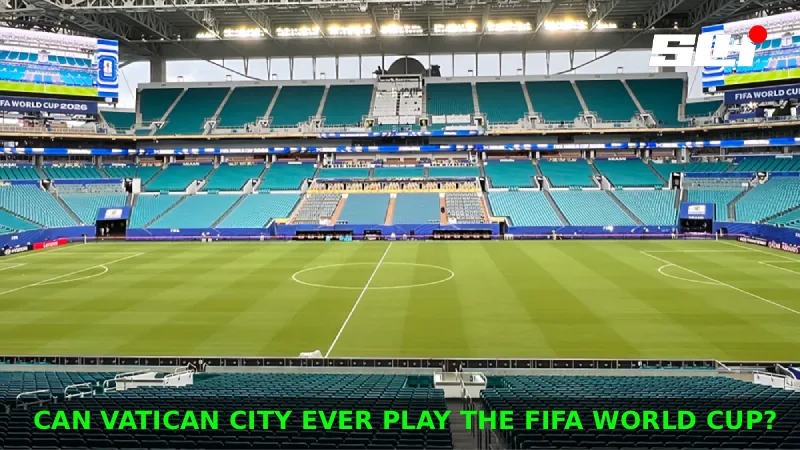


Nothing in FIFA’s rulebook stops the Vatican from applying. The blocker is the Vatican itself, not Zurich bureaucracy. Pope Francis’s own city-state already runs an eight-team domestic league, fields men’s and women’s national sides, and holds a reserved federation code that most member nations would envy. What keeps Vatican City on the outside isn’t infrastructure or eligibility. It’s a decades-old philosophical stance about what football becomes once money enters the picture, and whether that stance survives one change in leadership.
FIFA counts 211 member associations, more than the United Nations has member states. Nine sovereign nations sit outside that list: Vatican City, Micronesia, Kiribati, the Marshall Islands, Monaco, Nauru, Palau, Tuvalu, and the United Kingdom as a single entity, whose four home nations instead hold individual membership through a long-standing exception. Most of the eight non-Vatican holdouts are missing something concrete, whether that is a stadium meeting international standards or the plain geographic isolation that makes regular travel expensive.
| Country | Population | Football Association | FIFA Membership Barrier |
| Vatican City | ~800 | Yes (est. 1972) | Opposes professionalization; no application made |
| Monaco | ~40,000 | Yes (FMF) | No domestic competitive league; top club in French system |
| Marshall Islands | ~41,000 | Yes (MISF) | In early stages of building national infrastructure |
| Tuvalu | ~11,000 | Yes (TIFA) | Lack of international-standard stadium and facilities |
| Kiribati | ~119,000 | Yes (KIFF) | Lack of standard facilities and geographic isolation |
Vatican City breaks that pattern completely. Every item on the usual checklist already exists inside its 44 hectares, which turns its absence from FIFA’s rolls into a choice rather than a limitation.
The Federazione Vaticanese Giuoco Calcio was founded in 1972. Its national team played an unofficial first match in 1985, beating a side of Austrian journalists 3-0. The Vatican now runs an eight-team domestic league and a home ground, Campo Pio XI, plus men’s and women’s national squads drawing players from Swiss Guards, seminarians and Vatican employees. The women’s side was founded by Pope Francis in 2019.
FIFA has even reserved the country code VAT for whenever Vatican City decides to use it, a gesture that only makes sense for an association treated as a serious candidate.
FIFA’s Article 10 sets a simple bar: any national association responsible for organising football in its own territory can apply. Two further steps follow that first move. The relevant continental confederation, which for a European microstate means UEFA, must recognise the applicant, and FIFA’s Congress must then approve it by a three-quarter majority vote.
A UEFA spokesperson addressed the question in 2006, pointing out that the confederation already includes states with roughly 30,000 citizens, such as San Marino and Andorra, and that the pathway for a similarly sized applicant is simply to submit the paperwork. The mechanism has sat open and unused for two decades.
Population is clearly not the deciding factor. San Marino carries roughly 34,000 residents, Liechtenstein around 38,000, and Andorra close to 77,000, and all three hold full FIFA and UEFA status, regularly appearing in World Cup qualifying regardless of the scoreline. Kosovo secured membership in 2016 while its sovereignty remained a live dispute, proving political complication alone does not disqualify an applicant.
Former association president Domenico Ruggiero explained the reluctance in 2014, saying he preferred amateur status and worried membership would turn the team into a business. Reports surfaced in May 2023 that internal discussions about a UEFA application had resumed, though they never moved past the exploratory stage.
Every structural piece points toward eligibility rather than exclusion. The federation exists, the domestic league runs, the confederation pathway is documented and open, and smaller populations have joined without any real controversy attached. What remains is entirely a matter of institutional will inside the Vatican itself, not anything FIFA controls, oversees, or could plausibly change from its own side of the table.
That is precisely why Vatican City FIFA World Cup membership remains a live question rather than a closed one. The Church’s own leadership, not Zurich’s statutes, holds the only vote that has never actually been cast, and one successor with different instincts about sport and commerce could reopen the entire calculation overnight.
Would you want to see the Vatican actually apply, or does the amateur stance suit a nation this size? Drop your take in the comments.
As football fans globally search for the most reliable platforms to witness history unfold—especially with Argentina currently attempting to join this exclusive list in the 2026 World Cup Final—Sports Live Hub (SLH) emerges as the ultimate destination for premium sports broadcasting.
Finding a secure, uninterrupted broadcast during major international tournaments can be incredibly frustrating due to complex regional restrictions and geo-blocks. The hub sports live stream feature available on SLH operates as a state-of-the-art intelligent aggregator. It seamlessly maps your location and automatically routes you to verified, official regional broadcast feeds. This ensures that fans can watch every crucial moment of the World Cup in stunning high-definition, completely free from the irritating buffering issues and dangerous malware threats associated with illegal, unverified streaming websites.
Modern football enthusiasts demand a highly analytical and interactive viewing experience. The sport hub live streaming interface on SLH serves as an elite second-screen companion for dedicated fans. As you watch the world’s best teams compete for international glory, the platform provides dynamic, real-time digital overlays. Viewers gain instant access to advanced tactical data, including live Expected Goals (xG), detailed passing networks, and comprehensive player heatmaps, empowering them to dissect the beautiful game just like a professional television pundit.
During monumental events like a World Cup Final, internet searches for how to watch Sports live for free inevitably skyrocket. SLH proactively solves this challenge by maintaining a meticulously curated, fully localized directory of legal, free-to-air (FTA) broadcasting networks. By specifically highlighting public broadcasters that legally air these premium matches without requiring expensive subscription paywalls, SLH guarantees that the unparalleled excitement of international football remains completely accessible, safe, and entirely legal for millions of passionate fans worldwide.
Does Vatican City have a national football team?
Yes, and it has since 1972. The federation runs an eight-team domestic league plus men’s and women’s national sides, with a reserved FIFA code, VAT, waiting to be activated.
What are FIFA’s requirements for new membership?
Any national association organising football in its territory can apply under Article 10 of FIFA’s statutes. Approval then needs continental confederation recognition plus a three-quarter majority vote at FIFA’s annual Congress.
Which sovereign countries are not FIFA members?
Nine states sit outside FIFA, including Vatican City, Monaco and the Marshall Islands. The United Kingdom counts as a single entity there, since England, Scotland, Wales and Northern Ireland hold separate memberships already.
Has a small nation joined FIFA recently?
Kosovo became a full FIFA member in 2016 despite contested sovereignty at the time. San Marino, Liechtenstein and Andorra, all under 80,000 residents, already compete regularly in World Cup qualifying.
Why has Vatican City never applied to join FIFA?
Church leadership has resisted turning football into a commercial operation entirely. Former association president Domenico Ruggiero said in 2014 he preferred keeping the team strictly amateur.
 cricket
 football
 football