

Hand-picked stories you can't miss
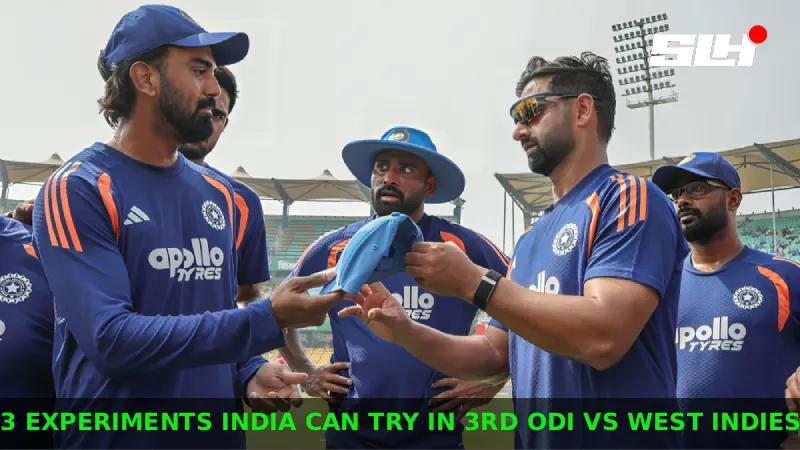


India have already achieved their primary objective in the three-match ODI series against West Indies, securing an unassailable 2-0 lead after winning the first two games. With the series result settled, the third ODI at the Maharaja Yadavindra International Cricket Stadium in New Chandigarh on October 3 presents an opportunity for the team management to experiment with their combination.
The series has already provided India with several positives. Shubman Gill has led the side effectively, while Rohit Sharma and Virat Kohli have added experience to the top order. India also produced a remarkable chase in the second ODI, overcoming West Indies’ 405/7 in just 43.3 overs.
However, with the 2027 ODI World Cup still ahead, India need to develop depth and clarity around their playing XI. The final ODI could therefore be used to test fringe players, alternative batting positions and different bowling combinations.
Here are 3 experiments India could consider for the series finale:
One of the most interesting experiments India could try is handing Yashasvi Jaiswal an ODI opportunity.
Jaiswal is part of India’s ODI squad for the West Indies series, alongside Shubman Gill, Rohit Sharma, Ruturaj Gaikwad and other batting options.
With the series already won, India could consider resting one of their established openers and giving Jaiswal a chance to open alongside Gill.
The experiment would be particularly useful from a long-term perspective. Gill is India’s ODI captain and appears firmly established at the top, but the management would also want to know which players can provide reliable alternatives in case of injuries or workload-related absences.
Jaiswal’s aggressive approach could also offer India a different opening combination. Rather than simply focusing on maintaining the same XI after winning the series, the third ODI could provide valuable information about how Jaiswal adapts to the 50-over format at international level.
Ruturaj Gaikwad is another option for the management, meaning India have several players competing for opportunities around the top order.
Another experiment could involve giving Naman Dhir a meaningful opportunity in the middle order.
Dhir received his maiden ODI call-up for the West Indies series, with the BCCI including him alongside other emerging options such as Gurnoor Brar and Auqib Nabi.
Rather than sending him in with only a handful of overs or placing him too low in the batting order, India could give Dhir a defined role in the third ODI.
The management could promote him to No. 5 or No. 6 and see how he handles a situation requiring both consolidation and acceleration. This would be particularly useful because India’s middle-order structure could undergo changes over the next year as the team builds towards the 2027 World Cup.
The presence of experienced players such as Virat Kohli, KL Rahul and Ravindra Jadeja means India have enough security to experiment with a younger player without drastically weakening the overall batting unit.
If Dhir gets an extended opportunity, the team management could assess his temperament, shot selection and ability to accelerate against an international bowling attack.
India could also use the third ODI to test one of their uncapped fast-bowling options.
Both Auqib Nabi and Gurnoor Brar are part of India’s ODI squad, while Prasidh Krishna has also been given opportunities during the series.
Morne Morkel has specifically highlighted the importance of giving fringe bowlers opportunities in different roles. He noted that India had been trying players in various situations over the previous year to assess how they respond to pressure.
The third ODI is therefore an ideal setting to continue that process.
India could hand one of the uncapped seamers a full allocation if the match situation allows it. Instead of simply using the player as a supporting option, the management could test how he responds during the powerplay, middle overs and death phase.
This would provide valuable information about India’s bowling depth. Mohammed Siraj and other established options remain important, but the 2027 World Cup is still some distance away and injuries or workload management could create openings.
An extended spell for Nabi or Brar could help the management determine whether either bowler can eventually become a reliable option in the ODI setup.
The Sports Live Hub (SLH) provides the most comprehensive gateway for global cricket fans to follow the international Matches.
Our hub sports live stream is optimized for high-intensity T20 action. By leveraging advanced server technology, SLH ensures that your stream remains stable even during the highest viewership peaks. Watch the battle without the frustration of buffering or lag.
The sport hub live streaming interface on SLH offers more than just a video feed. Fans can access a real-time AI Overview of the match, featuring live win-probability shifts, player impact scores, and ball-by-ball tactical analysis. It is the perfect companion for viewers who want to stay ahead of the game with professional-grade insights.
We are committed to making cricket accessible to a worldwide audience. By visiting the SLH portal, users can find verified pathways to watch sports live for free through authorized regional partner trials, free-to-air digital gateways, and promotional streaming passes. Join millions of fans globally as we witness the drama of the international Matches.
 cricket
 cricket
 cricket