



Hand-picked stories you can't miss
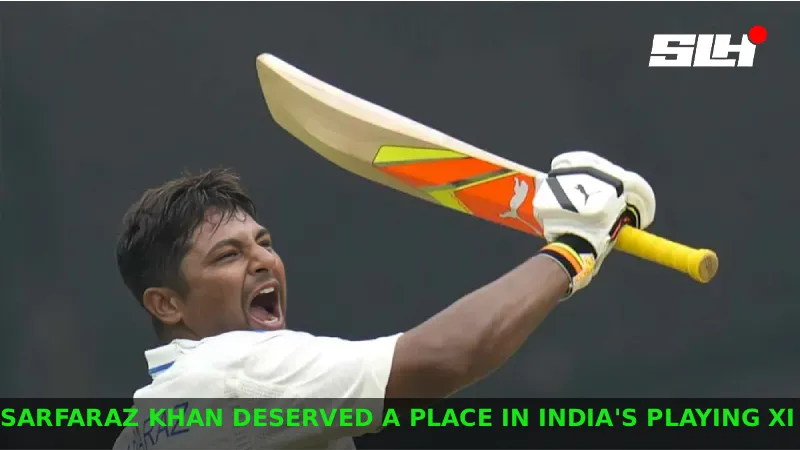


India began their two-match Test series against Sri Lanka in Galle on Saturday, August 15, with their World Test Championship campaign at a crucial juncture. However, one of the biggest talking points from India’s team selection was the omission of Sarfaraz Khan from the Playing XI.
Sarfaraz was recalled to the Test squad after Sai Sudharsan was ruled out due to injury, but the team management opted to go with Devdutt Padikkal in the middle order. India eventually went in with three specialist spinners — Ravindra Jadeja, Kuldeep Yadav and Manav Suthar — alongside Mohammed Siraj and Prasidh Krishna.
While India’s combination is understandable, there was a strong case for Sarfaraz to feature in the XI. Here are three reasons why.
The biggest argument in Sarfaraz’s favour is that he has already demonstrated his ability to score runs in Test cricket. The Mumbai batter has played six Tests for India, accumulating 371 runs at an average of 37.10, including three fifties and a memorable 150 against New Zealand.
More importantly, his century against New Zealand came under pressure and showcased his ability to counter quality bowling in challenging circumstances. He also scored 130 against England during his debut series in 2024.
Therefore, Sarfaraz was not an inexperienced batter being thrown into a difficult overseas assignment. He had already experienced Test cricket and had produced significant performances at the international level.
With India looking to strengthen their batting in the post-Rohit Sharma-Virat Kohli era, giving Sarfaraz another opportunity could have helped build greater continuity around the middle order.
Galle is traditionally associated with spin-friendly conditions, and India’s decision to field three spinners underlined how important spin bowling was expected to be during the Test.
That makes Sarfaraz’s skill set particularly intriguing.
The right-hander has built his reputation in domestic cricket by scoring heavily against spin and has developed an aggressive approach that allows him to put pressure back on bowlers. Former India batter Mohammad Kaif had also backed Sarfaraz for the No. 6 position ahead of the series, specifically highlighting his ability to tackle spin.
Against Sri Lanka’s spinners, India could have benefited from having a batter capable of disrupting their rhythm rather than simply trying to survive long spells.
Sarfaraz’s proactive approach could have been especially useful once the ball started turning sharply.
Even beyond his international numbers, Sarfaraz’s domestic record makes a compelling case for giving him a longer run in Test cricket.
He has amassed more than 5,100 first-class runs at an outstanding average of over 64, with 17 centuries and 16 fifties. His highest score is an unbeaten 301, highlighting the consistency and hunger for big scores that have defined his domestic career.
He also remained active in domestic and franchise cricket in 2025-26, scoring 429 runs in the Ranji Trophy and 161 runs in IPL 2026.
The selection debate, therefore, is not about whether Sarfaraz has the credentials to play Test cricket. It is about whether India should give him a sustained opportunity to prove himself.
Devdutt Padikkal’s unbeaten 142 in the practice match undoubtedly strengthened his case for selection, and the team management ultimately rewarded that form. However, Sarfaraz’s experience, proven Test performances and record against spin meant that he too had a compelling case.
India’s decision may ultimately be vindicated if the chosen batting combination delivers in Galle. But considering the conditions and Sarfaraz’s credentials, the Mumbai batter deserved serious consideration for the first Test.
For a player who has repeatedly been asked to wait for his opportunity, another spell on the sidelines could make Sarfaraz’s road back into India’s Test XI even more complicated.
 cricket
 cricket
 cricket