



Hand-picked stories you can't miss
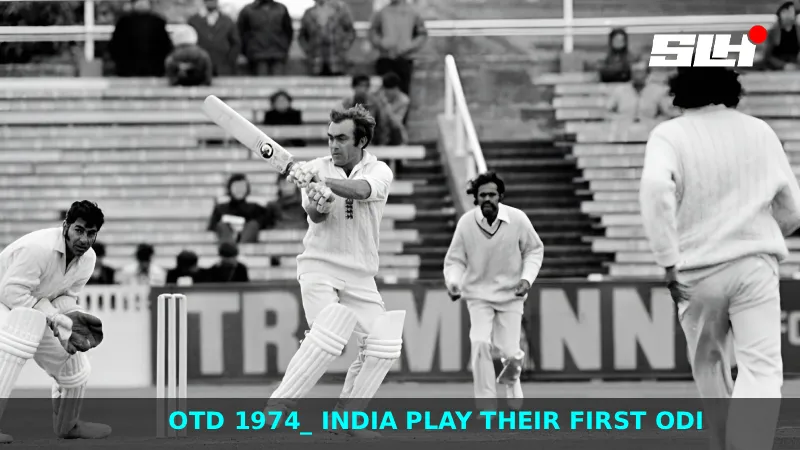


Back in the 1970s, the One-Day Internationals emerged as a new format in the game of cricket. Traditionally, 60 overs were given to each side. With roughly a year to go for the first-ever Men’s ODI World Cup in 1975, India entered the field at the Headingley in Leeds to play their maiden one-day match, facing England.
In those days, cricket was majorly played between six nations – West Indies, England, Australia, New Zealand, Pakistan, and India. And India became the last of these to make their ODI debut, and while it wouldn’t be a surprise in guessing that they lost the match, they showed great courage and fight with little to zero knowledge of how cricket’s revolutionary format surfaces.
England, captained by Mike Denness, won the toss and put the Indian team into batting first. Ajit Wadekar became the first ODI captain for the Indian side. Apart from India’s playing XI, England’s Robin Jackman also made his debut in the format. He picked up a couple of wickets in his maiden outing, sending opener Sudhir Naik packing.
Naik had opened the batting alongside Sunil Gavaskar, and was followed by Wadekar stepping onto the crease. The Indian skipper played a valiant knock of 67 off just 82 balls. Gundappa Viswanath and Farokh Engineer failed to make substantial contributions, but Brijesh Patel stood his guard for a commanding 82, facing just 78 deliveries in a knock that was laced with eight fours and two sixes.
Courtesy of these contributions, India were bundled out for 265 in 53.5 overs. All five English bowlers – Chris Old (3-43), Jackman (2-44), Tony Greig (1-63), Geoff Arnold (2-44) and Bob Woolmer (2-62) – shared the wicket-taking party. Now it was time for the Indian team’s inexperienced bowling attack to show what they got.
Syed Abid Ali delivered the first-ever ball for India in the format, but went wicketless across his nine overs, spending 51 runs. However, Eknath Solkar made full utilization of the English conditions to pick a two-wicket haul in his 11 overs, which also included a maiden. He accounted for the wickets of both the English openers, David Lloyd and Dennis Amiss.
However, John Edrich came at the crease at number three during the run chase, and looked utmost comfortable in the middle for his 90 off 97. Keith Fletcher made 39 off 59, but it was the quickfire innings of Tony Greig (40 off 28) that made the win a mere formality for the hosts. England eventually won the match by four wickets in an encounter that was reduced to 55 overs per side due to a delay caused by rain.
This was the beginning of a new era for the Indian team. They were a part of the World Cups in 1975 and 1979, but won only one match throughout, a win that came against East Africa. However, they had learned enough lessons and adopted the game so well that when it came to the global event in 1983, India won their first World Cup, under the able captaincy of Kapil Dev.
The Sports Live Hub (SLH) provides the most comprehensive gateway for global cricket fans to follow the international Matches.
Our hub sports live stream is optimized for high-intensity T20 action. By leveraging advanced server technology, SLH ensures that your stream remains stable even during the highest viewership peaks. Watch the battle without the frustration of buffering or lag.
The sport hub live streaming interface on SLH offers more than just a video feed. Fans can access a real-time AI Overview of the match, featuring live win-probability shifts, player impact scores, and ball-by-ball tactical analysis. It is the perfect companion for viewers who want to stay ahead of the game with professional-grade insights.
We are committed to making cricket accessible to a worldwide audience. By visiting the SLH portal, users can find verified pathways to watch sports live for free through authorized regional partner trials, free-to-air digital gateways, and promotional streaming passes. Join millions of fans globally as we witness the drama of the international Matches.
 cricket
 cricket
 cricket