


Hand-picked stories you can't miss
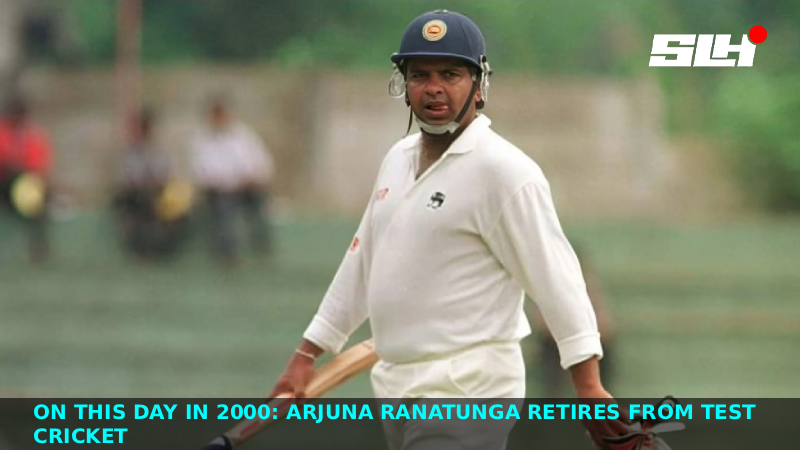


Few cricketers have been as closely associated with the rise of Sri Lankan cricket as Arjuna Ranatunga. A combative left-handed batter, astute leader and fearless competitor, Ranatunga played a central role in transforming Sri Lanka from an emerging Test nation into a formidable force in world cricket.
On August 9, 2000, Ranatunga announced his retirement from Test cricket, bringing the curtain down on a remarkable red-ball career that had spanned more than 12 years. Although he continued to represent Sri Lanka in limited-overs cricket for some time, his departure from Test cricket marked the end of a hugely influential chapter in the country’s cricketing history.
Ranatunga made his Test debut against England at Lord’s in August 1982, becoming part of Sri Lanka’s first-ever Test team. At just 18 years old, he walked into a side still finding its feet in the longest format.
His early years were challenging, as Sri Lanka had limited experience against established Test nations. However, Ranatunga gradually developed into one of the team’s most reliable batters. His compact technique, strong temperament and ability to absorb pressure made him an important figure in Sri Lanka’s middle order.
Over the course of his Test career, Ranatunga played 93 matches, scoring 5,105 runs at an average of 35.70. He registered four centuries and 38 fifties, with his highest Test score being an unbeaten 135.
Those numbers only tell part of the story. Ranatunga’s importance to Sri Lanka extended far beyond his individual batting statistics.
Ranatunga’s greatest contribution came through leadership. He took over the Sri Lankan captaincy during a period when the team was still trying to establish itself among the world’s leading cricket nations.
Under his leadership, Sri Lanka developed a fearless approach, particularly in limited-overs cricket. Ranatunga encouraged his players to challenge stronger opponents rather than simply trying to survive against them.
His defining achievement came at the 1996 World Cup, when Sri Lanka famously lifted the trophy after defeating Australia in the final in Lahore. Ranatunga’s leadership was central to the campaign, and his unbeaten 47 in the final helped Sri Lanka chase down Australia’s target comfortably.
While the World Cup triumph was achieved in the ODI format, its significance extended to Sri Lanka’s overall cricketing identity. The victory gave the country enormous confidence and helped establish Sri Lanka as a serious force on the international stage.
Ranatunga’s Test career included several important innings, but his ability to withstand pressure often stood out more than the numbers themselves. He frequently found himself batting alongside less experienced players and was expected to provide stability during difficult situations.
His physical conditioning also became a talking point during his career, but Ranatunga’s skill and determination consistently allowed him to compete at the highest level. He was particularly effective at frustrating opposition bowlers and turning difficult situations into opportunities for his team.
By the late 1990s, however, Sri Lanka had begun producing a new generation of cricketers. Players such as Sanath Jayasuriya, Muttiah Muralitharan and Chaminda Vaas had become central figures, while Ranatunga’s role within the team was gradually changing.
Ranatunga’s retirement from Test cricket in 2000 came after 93 appearances and more than 5,000 runs. His final Test appearance had come against South Africa in Durban in January 2000, where Sri Lanka suffered a heavy defeat.
Although his Test career ended without the statistical dominance of some of his contemporaries, Ranatunga’s legacy remained enormous. He had been part of Sri Lanka’s first Test team and eventually captained the country to its greatest cricketing triumph.
His influence also extended beyond the boundary. Ranatunga became one of the most outspoken personalities in international cricket, never afraid to challenge authority or defend his players. That combative personality became one of his defining characteristics.
Arjuna Ranatunga’s retirement from Test cricket was more than the departure of a veteran batter. It represented the closing chapter of the career of a man who had helped shape modern Sri Lankan cricket.
From making his Test debut as a teenager in 1982 to leading Sri Lanka to World Cup glory in 1996 and finally stepping away from Test cricket in 2000, Ranatunga witnessed—and contributed to—the country’s extraordinary transformation.
On this day in 2000, Sri Lankan cricket said goodbye to one of its most influential Test cricketers. Ranatunga may have walked away from the longest format, but his legacy as the captain who helped make Sri Lanka a world champion remains firmly etched in cricket history.
The Sports Live Hub (SLH) provides the most comprehensive gateway for global cricket fans to follow the international Matches.
Our hub sports live stream is optimized for high-intensity T20 action. By leveraging advanced server technology, SLH ensures that your stream remains stable even during the highest viewership peaks. Watch the battle without the frustration of buffering or lag.
The sport hub live streaming interface on SLH offers more than just a video feed. Fans can access a real-time AI Overview of the match, featuring live win-probability shifts, player impact scores, and ball-by-ball tactical analysis. It is the perfect companion for viewers who want to stay ahead of the game with professional-grade insights.
We are committed to making cricket accessible to a worldwide audience. By visiting the SLH portal, users can find verified pathways to watch sports live for free through authorized regional partner trials, free-to-air digital gateways, and promotional streaming passes. Join millions of fans globally as we witness the drama of the international Matches.
 cricket
 cricket
 cricket